Benefits Management is one of those topics everyone agrees is important, yet many organisations still struggle to do it well. Projects complete, programmes close, and reports are produced, but the question executives continue to ask is simple: What value did we actually get?
This is where Benefits Management comes in, and it is also where the PMO plays one of its most important roles.
This blog brings together the key learning from our Benefits Management and PMO blogs, to create a single guide you can return to again and again. Whether you are new to Benefits Management or looking to mature your PMO’s approach, this is everything you need to know in one place.
What Is Benefits Management and Why It Matters to PMOs
Benefits Management is the structured approach to identifying, evaluating, planning, tracking, realising, and reviewing the value expected from change initiatives. It is not just reporting, and it is not something that starts and ends with the business case.
What matters most is that benefits are:
- Clearly defined so everyone understands what success looks like in plain business language.
- Measurable so progress can be tracked and decisions can be made with evidence rather than opinion.
- Owned by the business so benefits are not treated as a project team responsibility that disappears at closure.
- Actively managed so risks to benefits are identified early and benefits remain visible through delivery and beyond.
Too often, organisations treat benefits as something written into a business case and forgotten once delivery starts. The project might still be delivered perfectly on time and on budget, but the organisation struggles to see meaningful value because outcomes were never actively enabled, monitored, or sustained.
Benefits Management shifts the focus from delivering outputs to achieving outcomes.
If you want a dedicated starting point, our blog PMO: Getting Started with Benefits Management walks through the early steps and common challenges when organisations introduce Benefits Management for the first time.
The Benefits Management lifecycle PMOs need to understand
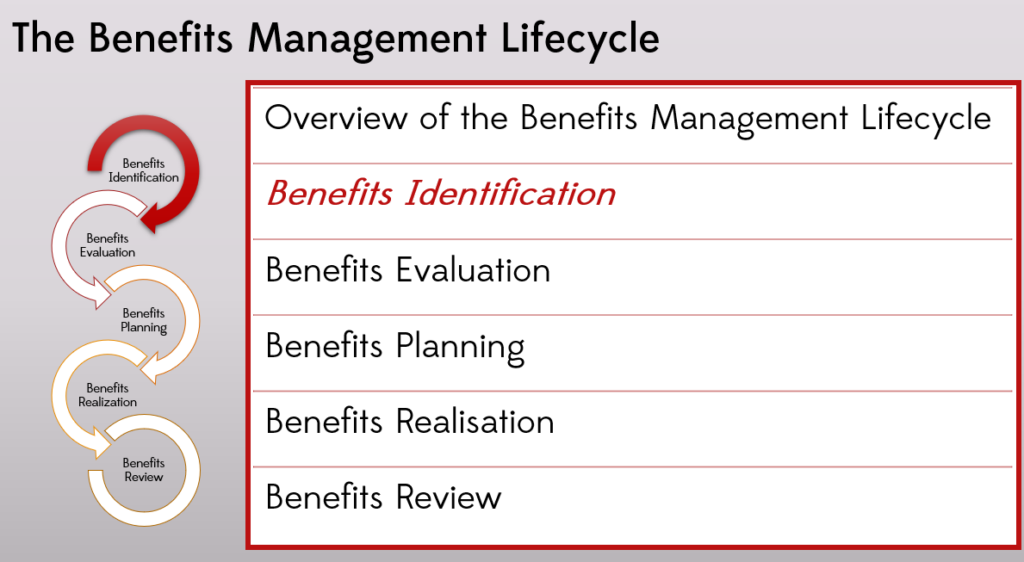
When PMOs support Benefits Management, they are really supporting the lifecycle. Getting the lifecycle right matters because it prevents the classic pattern of benefits being discussed early, forgotten during delivery, and argued about later when nobody can prove whether they happened.
Here’s the lifecycle in a practical, PMO friendly way.
1. Benefits Identification
This is where benefits are defined and clarified. It includes surfacing the full range of expected benefits and disbenefits, agreeing what “good” looks like, and ensuring benefits align to organisational objectives. For PMOs, this often means making sure benefits are captured consistently, supported by the right templates, and connected clearly to the reason the initiative exists.
2. Benefits Evaluation
Not all benefits are equal, and not all benefits are realistic. Evaluation is where benefits are assessed for value, feasibility, and credibility. This stage helps decision makers understand which initiatives are worth investing in, which benefits are measurable, and what assumptions or dependencies need to hold true for value to materialise.
3. Benefits Planning
Planning is about setting out how benefits will be achieved. This is where benefits mapping and profiling come in, connecting outputs to changes in the business and ultimately to outcomes. It is also where ownership is made real. A benefit without an owner is usually a benefit that never happens.
4. Benefits Realisation
During delivery and after go live, benefits need to be tracked and monitored. This does not mean simply updating a register. It means reviewing progress, identifying emerging risks, and using benefits insight to inform decisions. This is where PMOs often add the most value by providing structure and visibility.
5. Benefits Review
This stage is often missed. Benefits can take months or years to materialise, and many benefits need reinforcement to be sustained. Review is where you confirm what was realised, learn from what did not happen, and improve future investment decisions.
Our blog The PMO’s Role in Benefits Management goes deeper into how PMOs support benefits across this full lifecycle and why it is not just an administrative activity.
Why Benefits Management is hard in real organisations
Benefits Management looks simple on paper. In practice, it is one of the hardest areas of change governance to embed. Common reasons include:
- Benefits can be difficult to define, especially when they are intangible or long term, such as improved decision making or customer trust.
- Benefits measurement is often inconsistent because teams use different definitions, different metrics, or different reporting approaches.
- Benefits rely on adoption and behavioural change, which means realisation depends on what happens after delivery, not just what is delivered.
- Benefits ownership can be unclear, especially when delivery teams move on and operational areas are left to embed changes without structured support.
- External factors such as policy shifts, market conditions, organisational restructures, or leadership changes can affect whether benefits are still valid or achievable.
The PMO’s job is not to magically remove these challenges, but it can create the structures that make them visible and manageable.
The PMO’s role in Benefits Management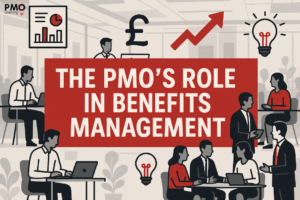
The PMO plays a central role in ensuring benefits are identified, measured, and realised consistently. It provides structure, governance, and insight that help turn project outputs into business results.
In practical terms, this means the PMO can:
- Create a consistent approach so benefits are defined and tracked the same way across projects, programmes, and portfolios.
- Support benefit owners and sponsors by providing clear templates, guidance, and reporting.
- Provide visibility and insight by analysing benefits progress, identifying risks, and highlighting exceptions early.
- Embed governance so benefits are reviewed as part of decision making, not treated as a side topic.
- Connect benefits to strategy so leaders can see whether investments are delivering what the organisation actually needs.
Who does what in the PMO when it comes to benefits?
Benefits Management is not the responsibility of a single PMO role. It is a shared discipline across PMO levels, and in more mature environments, specialist roles may exist.
PMO Administrators
They maintain benefits registers, keep tracking tools up to date, and ensure reporting data is consistent and accessible. Their work is the foundation that makes benefits information usable and trusted.
PMO Analysts
They interpret benefits data, identify patterns and risks, and provide insight into whether benefits are likely to be realised. Analysts help decision makers move from reporting to action.
PMO Managers
They define and embed Benefits Management frameworks, governance, and repeatable processes. They ensure benefits are aligned to organisational goals and supported by consistent PMO services.
PMO Directors and Heads of PMO
They operate at the strategic level, ensuring benefits realisation is front of mind in portfolio decisions. They provide assurance to senior leaders that investments are delivering what was promised.
Specialist roles in more mature environments
Some organisations also use dedicated roles such as Benefits Realisation Managers, Business Change Managers, Portfolio Benefits Leads, and Measurement and Analytics Specialists. These roles help bridge delivery and business value, ensuring benefits are not just captured on paper but realised in practice.
How PMO maturity shapes Benefits Management
The way a PMO approaches Benefits Management often reflects its stage of maturity.
Early stage PMOs typically focus on capturing benefits in registers and producing reports. Visibility improves but influence is limited.
Developing PMOs move beyond tracking into benefits mapping, profiling, and monitoring during delivery. Benefits start to influence day to day decision making.
Strategic PMOs integrate benefits into portfolio management and investment decisions. Benefits are used to prioritise work, manage dependencies, avoid duplication, and provide assurance to executives that value is delivered and sustained.
This maturity journey is one of the clearest pathways for PMOs to move from being seen as bureaucratic to being seen as value-led.
Building Real Capability in Benefits Management
Understanding Benefits Management is one thing. Applying it consistently and confidently in your organisation is another.
This is why we created our Benefits Management and the Role of the PMO two-day course.
The course is designed specifically for PMO professionals and focuses on the practical realities of making Benefits Management work. It takes you through the full Benefits Management lifecycle, showing how PMOs support value from early identification through to post-delivery review and benefit sustainability.
The course covers:

The end-to-end Benefits Management lifecycle and how it works in practice.
-
The specific role of the PMO at each stage.
-
How Benefits Management links to business cases, change management, and portfolio decisions.
-
Practical tools, techniques, and artefacts PMOs use to support benefits consistently.
-
Common challenges PMOs face and how to overcome them.
A key feature of the course is the course journal. Participants use the journal before, during, and after the course to reflect on their current approach, capture insights, and build a clear, prioritised action plan tailored to their organisation. The journal ensures learning translates into real workplace change.
We deliver the course in our highly interactive virtual classroom as part of our public schedule, allowing PMO professionals to learn alongside peers from other organisations and share real-world experiences.
We also deliver the course in-house, tailored to your organisation, your PMO services, and your strategic priorities. This option is ideal for PMO teams who want to build a shared understanding of benefits management and apply it consistently across projects, programmes, and portfolios.
If your PMO wants to move beyond reporting delivery and start demonstrating real value, this course provides the structure, confidence, and practical capability to make that shift.
Explore the Benefits Management and the Role of the PMO course.
View upcoming public virtual classroom dates.
Talk to us about running the course in-house for your PMO or organisation.